Why Marching Band Makes a Great Setting for Fiction
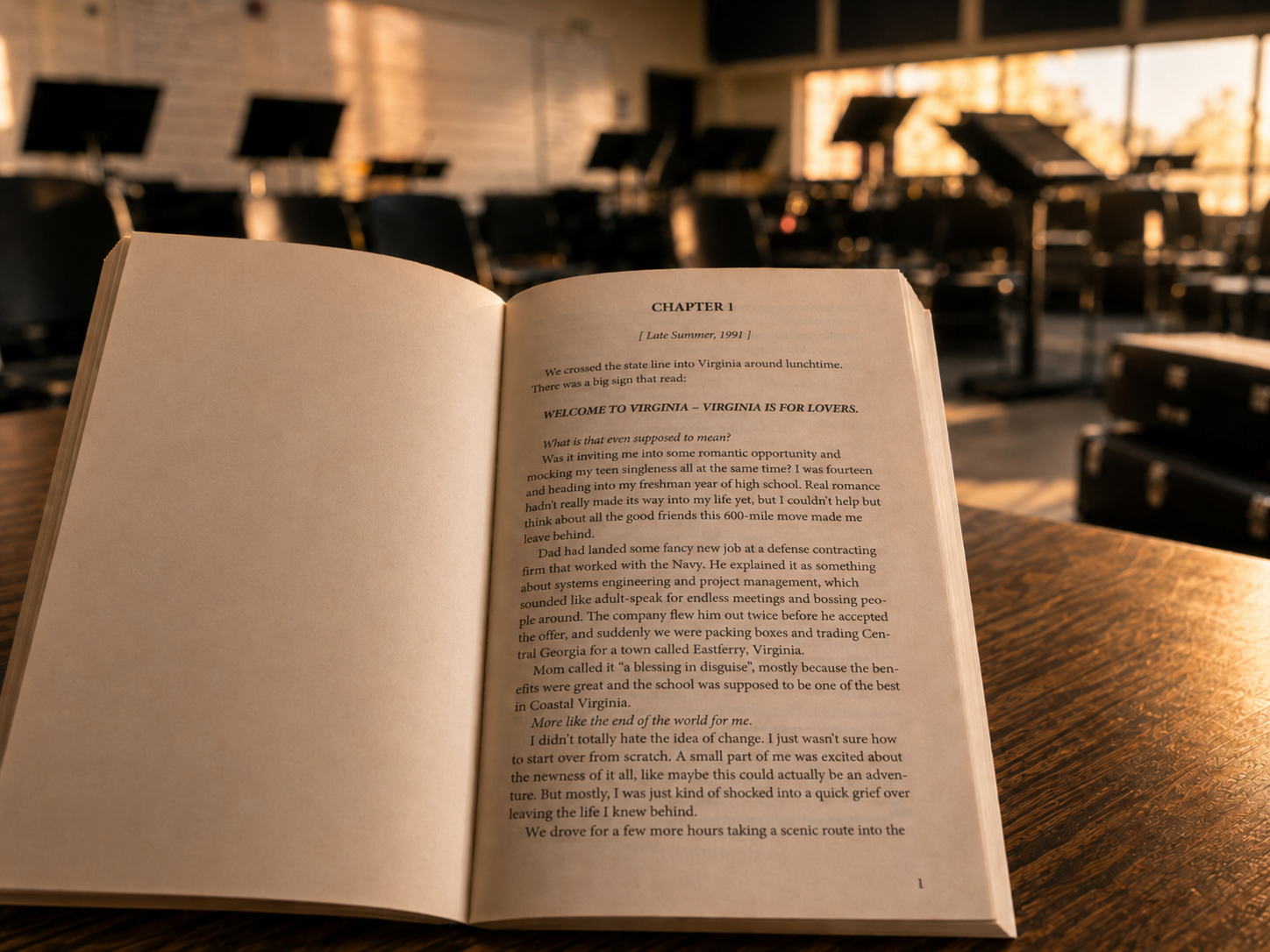
Marching band comes with built-in story.
There are auditions, section leaders, first games, long rehearsals, missing pencils, bus rides, contest nerves, uniforms that never quite fit right, and directors who say “one more time” with no apparent concern for the truth.
For a writer, that is useful material.
For a reader, it is even better. Band gives a story pressure, humor, movement, music, friendship, embarrassment, and that strange feeling of trying to become part of something bigger while also figuring out who you are.
That is one reason I write band geek fiction. The band room is already full of stories. Fiction just gives us a way to follow them.
A Band Is an Instant Cast of Characters
One of the best things about writing marching band fiction is that a band already has an ensemble.
There is the serious section leader who owns three pencils and will not lend any of them out. There is the freshman trying to look like they know where to stand. There is the senior who has seen too much. There is the trumpet player who is louder than necessary, the percussionist tapping on everything within reach, and the clarinet player who somehow has snacks.
A band gives a novel people with different jobs, different personalities, and different levels of confidence. They all have to share the same room, the same field, the same bus, and the same performance schedule.
That creates friction. It also creates friendship.
In a marching band novel, characters do not have to be forced together by coincidence. They are already together. They rehearse together, wait together, sweat together, mess up together, and sometimes get it right together.
Everyone Has a Part
A marching show only works if everyone does their part.
That sounds simple until you remember that everyone’s part is different. The melody may be in one section while another section holds the rhythm together. Someone is moving backward. Someone else is trying not to collide with a sousaphone. The drum major is watching the director. The director is listening for something most people in the stands will never notice.
A quiet character can still carry something important. A loud character can hide behind noise. A mistake by one person can ripple through the group. A small act of kindness can change the way someone survives the season.
That is especially useful in YA music fiction, where so much of the story lives in the tension between wanting to stand out and wanting to belong.
Early at Jameson High, Wesley is overwhelmed by the standard, but something in him still answers it: “I belong here.”
Rehearsal Shows Who People Are
Rehearsal is not glamorous.
It is hot. It is repetitive. It is full of corrections. Someone is always late. Someone is always confused. Someone is always convinced the problem is definitely not their section.
And then the director sends everyone back to measure 32.
Again.
That kind of repetition can reveal a lot about a character. Who listens? Who shuts down? Who blames someone else? Who helps the person beside them? Who gets better when nobody is praising them for it?
A performance shows what a band can do. Rehearsal shows what a band is made of.
The best story moments are not always the big contest or the final note. Sometimes they happen when a tired student quietly explains the drill to someone who is lost. Sometimes they happen when a character finally admits they do not understand the rhythm. Sometimes they happen when the group is so close to getting it right that everyone can feel it, even before they can play it cleanly.
Those are small moments, but they matter.
The Field Makes Mistakes Visible
Marching band is wonderfully unfair to anyone hoping to hide.
If you are out of tune, people can hear it. If you are out of step, people can see it. If you are in the wrong place, the form tells on you. If you forget where you are going, there is usually someone nearby trying very hard not to run into you.
That makes the field a strong setting for fiction.
It gives the character a physical version of growing up. You can be unsure, late, off-balance, too loud, too quiet, or looking at the wrong person for direction. You can lose the count and still have to keep moving.
Most people know that feeling, even if they have never marched a step.
Growing up often feels like trying to recover before anyone notices you missed the set.
In Into the Rising Storm, Wesley learns fast that Jameson is not casual. After band director Halbrook’s opening speech, he realizes, “This wasn’t play time. This was serious marching band.”
Music Raises the Stakes
A football game already has noise and lights and motion. Add a band to it, and suddenly there is another layer: the fight song, the stands tunes, the warmup, the show music, the drum cadence that makes everyone walk a little differently.
Music can say what a character is not ready to say out loud.
That matters here. A student may not be able to explain fear, pride, grief, anger, hope, or joy in a neat paragraph. But they may be able to play it. They may be able to hear it in someone else’s sound. They may understand another person better because of the way they breathe before a solo or rush a phrase when they are nervous.
In Me & the Marching Bands, Wesley Wade’s music is more than a talent he brings from school to school. It is one of the ways he enters new rooms, finds his footing, and learns to be heard before he always knows what to say. Before anything else, he is still what he has always been: “Trumpet player. Musician. Songwriter.”
The Band Room Is Its Own Little World
Every band room has its own weather.
Some are strict and polished. Some are chaotic in a way that somehow still works. Some feel like a second home. Some feel like a place where you have to prove yourself before anyone makes room.
There are instrument cases, old chairs, music stands, valve oil, reed cases, uniform racks, forgotten water bottles, and at least one pencil that has been sharpened down to a dangerous little nub.
There are inside jokes that make no sense outside the room. There are traditions nobody remembers starting. There are seniors who act like they own the place and freshmen who are still learning which cabinet is safe to open.
That is why the band room works so well in fiction. It is not only a location. It is a culture.
When a character walks into a new band room, they are not just entering a class. They are entering a small society with rules, history, favorites, grudges, expectations, and a sound all its own.
For Wesley, that matters because Me & the Marching Bands follows him through four different schools and four different band programs. Each one has its own personality, and each one asks something different of him.
Band Creates Pressure Without Needing Villains
A good story needs pressure, but that pressure does not always have to come from a villain.
Marching band brings pressure naturally.
There is pressure to learn the music. Pressure to make the form. Pressure to keep up with stronger players. Pressure to not embarrass your section. Pressure to perform in front of people who may not understand how much work went into those eight minutes on the field.
There is also the quieter pressure of wanting to be accepted.
That is the kind Wesley faces again and again in Me & the Marching Bands. He is not simply learning new shows. He is learning new people, new directors, new expectations, and new versions of himself.
Each band gives him a different challenge. Jameson brings discipline and tradition. Voyager brings warmth and expression. Northwest brings disruption and rebuilding. Harlowe County brings leadership and the question of what it means to finish well.
Across Me & the Marching Bands, Wesley attends a different high school in each book, and each band has its own language. Jameson High’s Sentinel Sound speaks in discipline, precision, and competition. Voyager’s Band of Gold speaks in warmth, looseness, and oldies-show fun. Northwest High’s Pride of Northwest speaks in chants, stomps, cranking trumpets, horn flips, dance breaks, and high steps that snap. Harlowe County High’s Marching Hornets speak in theatrical, small-town spirit—steady, heartfelt, and a little bittersweet as Wesley learns what it means to lead from the place he has finally found.
Performance Gives the Story a Clock
Marching band seasons move toward something.
The first game. The first public performance. The big contest. Senior night. The last show of the season.
That gives fiction a natural clock. The characters cannot sit around forever deciding who they want to become. The calendar keeps moving. The performance date is coming whether they are ready or not.
That makes the emotional stakes sharper.
A student may be struggling with confidence, friendship, grief, moving, jealousy, leadership, or fear of failure, but the show still has to be learned. The bus still leaves at a certain time. The uniform still has to be zipped. The music still starts when the drum major counts off.
There is something very honest about that.
Life does not pause until we feel ready. Neither does marching season.
Why Readers Recognize This World
Former band kids may recognize the details first.
The heat. The shoes. The stands. The strange power of hearing the whole band hit a chord together. The way a bus ride could turn into its own tiny civilization before you even got to the game.
But readers do not have to be former band kids to understand the feeling.
Most people know what it feels like to walk into a room where everyone else already knows the rules and to make a mistake in front of them before you do.
Marching band just makes those feelings visible, audible, and occasionally sweaty.
It just gives all that regular, awkward, figuring-yourself-out stuff somewhere specific to happen with a soundtrack and seventy other people who are also lost.
The Story Is Already on the Field
A marching band has rhythm, conflict, humor, pressure, music, friendship, and motion.
It has the big moments under the lights and the small ones back in the room. It has the students who want to lead, the students who want to disappear, and the students who are still figuring out which one they are.
That is why I keep coming back to it.
Band is not just scenery for these stories. It shapes the way characters listen, fail, recover, connect, and grow.
R.K. Slade